
Why Cooperate?
Reflections three years into starting and running a teaching cooperative.

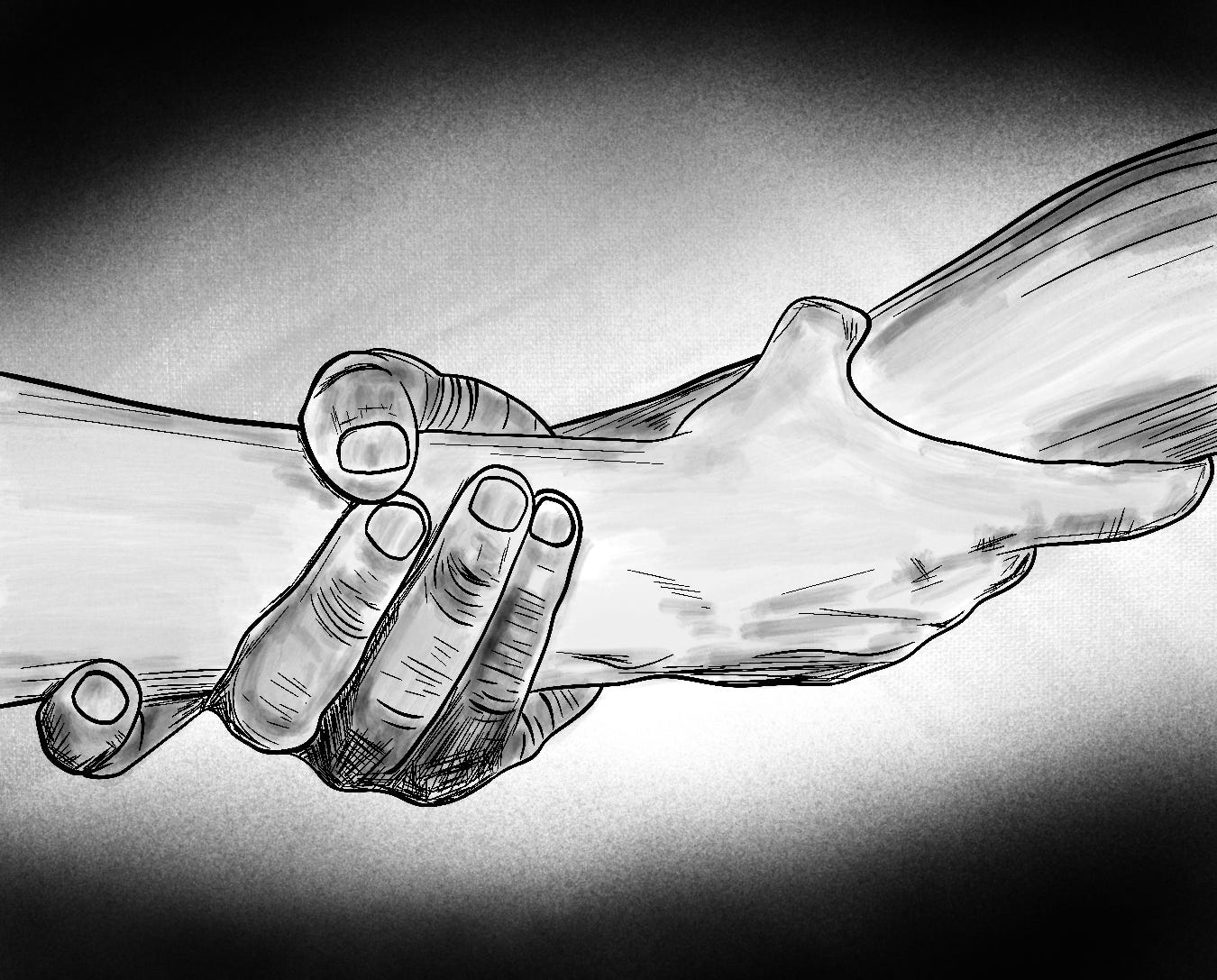
Growing up in the Philly ‘burbs as I did, I never encountered the word cooperative, or socialism, but I did know about the loaves and fishes. That story came up regularly in Catholic school, how all these people gathered in the desert to hear Jesus preach one afternoon and then, as evening approached, the disciples realized there was no food for them. A collection was taken up which yielded five loaves and two fishes (seven things in total; perfection in Christian numerology). This meager amount was passed around and in the end there was more than enough food for the whole crowd.
My teachers called it miraculous – in other words, Christ magic, like walking on water and raising the dead. The lesson was that if you believed in Christ, he would work that magic on your behalf and provide. Even then I saw that as a misreading; the loaves and fishes is a parable about sharing.
I was a Muppets kid. A Sesame Street kid. A Mr. Rogers kid. I was also a loner of a kid, often in my head, so these characters, who I watched every day on beloved PBS, felt very real to me. They all celebrated the value of sharing. Take only what you need, contribute what you can; we’ll make do. Financially, my family lived on the cusp of poverty. Hand-me-downs and second-hand things were a norm in my early childhood. The only reason my parents could afford to send me to Catholic school was because Mom worked there part-time, running the mimeograph machine and selling lunchtime Nutty-Butties and pretzels that were as bland as eucharist wafers, to shave money off the tuition.
So, at seventeen, when I encountered the concept of a cooperative as a prospective student at Oberlin College, I immediately got it – no, even deeper than that, it felt familiar. The brochures described the Oberlin Student Cooperative Association (OSCA) as a system of dorms and dining halls where students did all the chores, lived with no direct supervision from the college, and therefore paid less room and board fees. They were community centric. Everyone ate together, and coops hosted parties for the house as well as for the campus. Sure, coops required more labor, since there was no cleaning or cooking staff waiting on you, but that felt right to me. As a high school student, I cleaned my room regularly every week, and, unasked, did chores around the house when I saw they needed doing. I didn’t want some underpaid college staffperson taking care of me like I was a child. I was happy doing that for myself.
Besides, my parents said Oberlin was too expensive, but since they had never gone to college and largely left me to my own when researching them, Oberlin was the only school I had applied to, early decision no less. I was determined to get there, whether through loans (which I’m still paying off), bookstore jobs on breaks and summers, the student work program during the semester, or joining a cooperative. I’d do anything to earn or save a buck! To me, these cost saving and money making measures weren’t hardships, just necessities.
And mostly pleasant ones too. I loved working with others, and flourished in the coop system. My second year, I took on a leadership position in the cooperative where I lived, kind of like an RA but with the added responsibility of making sure everyone had a chore to do and that those chores got done. I ran house meetings where we decided on policies and community standards. I mediated when students had conflicts. I held hands, and sometimes heads, over toilet bowls, when my housemates over indulged. I learned a lot that year, one being that I was good with a budget. We used a small amount of our funds to organize a campus-wide Halloween party. Karen O, before Yeah Yeah Yeahs fame, played with her band. Everyone in the house had a job, from setting up the sound system to pouring beer. We charged two or three bucks at the door and made many times over what we put into it, money that went toward community events and, at the end of the year, any leftovers were distributed to the coop members.
Fast-forward some decades. In my early forties, I was an at-home parent, a freelancer, a writer struggling to complete and publish creative work, and a teacher when I encountered these sentences in Alexander Chee’s seminal essay “On Becoming An American Writer:”
I began teaching writers in the fall of 1996, at a continuing education program based on the Upper West Side of Manhattan. I called it the MASH unit of creative writing, because you can’t turn anyone away from your classes there. The program pays instructors what it has always paid them, even now, twenty years later, and they do so because there is always an MFA graduate like me who needs a first teaching job, and every other place that offers writing classes in New York is more or less like this.
I was doing the same but my MFA graduation was a decade in the rear view mirror. I had been a middle school teacher and was now committed to being a teacher of adults, but had long felt Chee’s frustration. The organizations I had been working for took, at best, fifty-five to sixty percent of the student tuition for administration (some took even more than that!). Many of the people I met working at those organizations were wonderful, creative folk, but rarely did they have anything nice to say about the organizations themselves, which overworked and underpaid them, and where they struggled to feel a sense of power. This upset me. I have a history of disgruntlement when laboring for organizations that I don’t believe in – I walked away in disgust from Hearst, for example, because corporate life is ick; I walked away in disgust from the Department of Education in New York City for similar reasons. Big systems aren’t for me, but these organizations I worked for weren’t big, they should be better than that.
I was frustrated too with a lack of connection among my colleagues. Lack of connection – that’s a nice way of putting it. Often, I encountered a sense of proprietary-ness or competition among fellow teachers. People who, for instance, wouldn’t share what was on their class reading list because they feared someone stealing it, and who disdained pedagogy because they were only teaching for the money, not because they enjoyed or believed in it. No, what they’d rather be doing was writing full-time.
Well, I love writing too, but I had come to know that my creativity flows in many directions – I also like making things, and I love working with other people, especially since much of my time as a writer is solitary, and I adore teaching and truly feel in my heart that it’s a beautiful, human thing, to gather with other people, to discuss stories and craft and life, to share with one another. Maybe this too is a kind of loaves and fishes.
I had the impression that these continuing ed organizations saw me as only another warm body to put in a classroom, a means of making money. They had no vision for their students but were instead playing on people’s dreams of one day publishing a book, pitching their classes as a means to that end without investigating whether the classes they were selling actually helped or, instead, fed false narratives about writing, and the creative life, and the chances of publishing, and the outcomes of publishing which, for most writers, doesn’t mean achieving fame and fortune. What I mean is, some of these orgs, at worst, were selling snake oil. I taught students who, over the course of years, shelled out thousands of dollars for various classes, programs, and conferences. These things helped them finish a book about as much as my MFA had helped me – very little.
I’m a determined motherfucker. I figured I could, with help, make anything as good or better than the organizations I had been working for. The question was, how? So, I began asking around to see if any friends and colleagues who taught would be interested in starting something new, an organization that we could jointly own and feel empowered in, because we built it together, an organization where the value of community engagement was baked in, along with a promise of not exploiting workers, but instead, all of us sharing and sweating together as we push this thing along. A cooperative.
Most folks said no, echoing what I used to hear at Oberlin about student cooperatives, or hear today about the Park Slope Food Coop (where I’ve been a member for almost twenty years), which is that they just don’t have the time or energy for such an intense commitment. Writers can also be surprisingly uncreative when it comes to finding new ways to do old things. They prefer teaching for existing orgs, or publishing with familiar houses, than doing something different. I get it – going on your own can feel… well, lonely. Scary. But fortunately I found Sara Lippmann and Amy Shearn were down to collaborate, and three years ago Writing Co-Lab was born.
The foundational idea has always been this: that by teachers working together, and taking on some of the administration work themselves, then they can not only bring their unique voices and experiences to the classroom, they can also earn the majority of the student tuition. So far, we’ve been successful at that, with teachers earning between 80 and 90% of what students pay. Our classes have helped students navigate the publishing world, but also, rather than constantly feeding into the capitalist dream machine of corporate publishing, we’ve also educated them on alternative ways to distribute work as well as modeled how to cultivate a love of process itself. Creativity can be its own reward! Especially when you realize that as a sensitive, feeling, thoughtful, active individual, you are not alone.
We are always trying, and will always be trying, to operate better for our teachers and our students, but the organization works. We function as a socialist-minded enterprise within a capitalist system, to the extent that we’re able. We weren’t alone when we started and today we’re less alone than before, as writers and teachers seem more determined than ever to take the means of production and distribution, whether as educators or artists, into their own hands, in part a necessary reaction to systems that are sick if not broken, built on hollow ideologies that are dehumanizing and competitive in nature, bullshit ideologies that have done nothing but wreck havoc on people and this planet. I’m looking at you, Scrappy Lit ( Chloé Caldwell Alex Alberto), and Quilted Press, and The Ministry of Words (R. O. Kwon 권오경 Ingrid Rojas Contreras)! We see this turn toward socialism on a bigger stage too, at least here in New York, with our first Democratic Socialist mayor.
Last week, when Lincoln Michel wrote about the “need to adopt a punk rock mindset. It is DIY or die. We have to do this ourselves. We need to build our networks, fund what we can if we have the resources, and steal what we can from institutions while we can, knowing those resources will always be ephemeral,” the hair on the back of my neck raised in a somatic response. Yes. Though my tastes for punk run more toward the pop than the hardcore – The Ramones, early Green Day – I am a 90’s youth through-and-through, forever making zines in my room, and damn if The Muppets, as they existed when Henson lived, weren’t a little punk too, tossing together bits and scraps of both material and culture to create something unique and strange.
Here again are the loaves and fishes. When small, people-forward orgs succeed, they inspire others to do the same. When we work together, we are not lessened but made greater. Cooperation, not competition – that’s some punk shit right there. We have a lot to weep and gnash teeth about these dark days, but our moxy, and our insistence, is inspiring, is its own kind of magic.
We wholeheartedly agree with this @ thedreamside.substack.com !! ☁️☁️
Yessssss ❤️❤️❤️